Alex, the African grey, was a revelation to people all over the world, and especially to the scientific community. In Alex & Me, Dr. Irene Pepperberg tells the story of how her work with Alex — the structured training and testing that she did — proved that he had the intelligence of a four-year-old child. She also recognized that Alex became her true companion as the two of them established a close bond over the thirty years they were together. Alex appeared on television shows many times, and there are a lot of YouTube videos that demonstrate his skills. I believe that anyone who enjoys animals would like this book.
Dr. Irene Pepperberg had a series of parakeets, or budgies, when she was growing up. She quickly learned that they could understand what she said, learn to talk, and show affection. She majored in chemistry, received a doctorate, and then changed her focus. Her goal was to prove that a parrot is capable of using cognitive processes that only humans and higher primates were thought to achieve.
African grey parrots are known for their intelligence, so to begin her work she bought a one-year-old grey at a pet shop. With an assistant, she began to work with him. He learned to recognize colors, shapes, and names of objects. After a couple of years, she began submitting articles to scientific journals. She called her studies Project ALEX: Avian Language Experiment, and that’s how Alex got his name.
This led to a grant from the National Science Foundation, where she began her work at Purdue University. She changed universities a few times and the grants continued, which included payments for her assistants. She also taught classes. During a lean period, her husband told her to “get a real job and forget this bird nonsense.” They divorced soon after that. She was completely dedicated to her work. She acquired other greys, and had success with them as well.
Most people believed that parrots talked by mimicking what they heard without understanding it. Bird people know differently. The first pet I had was a parakeet and I quickly learned how wonderful a bird could be. Cuddles was friendly, tame, loved to sit on my shoulder and fly to my hand when I held my arm up. He learned to talk, and became my friend and companion as we continued to bond over the years. I have had many parrots after that and they were all different. Some talked better, some cuddled more, and some were very intelligent. Coco, a Meyers parrot, was also very intelligent. He said “night night” when it was time for him to go to bed. I had other birds who picked it up from him, but said it randomly. This got Coco very upset — he didn’t realize they didn’t know what it meant. Stickley, a Pionus that was a rescue, took two years of daily work before she trusted me. After that, she loved sitting on my shoulder and being stroked. I developed a bond with all of them, joined a bird club, and wrote articles for Bird Talk.
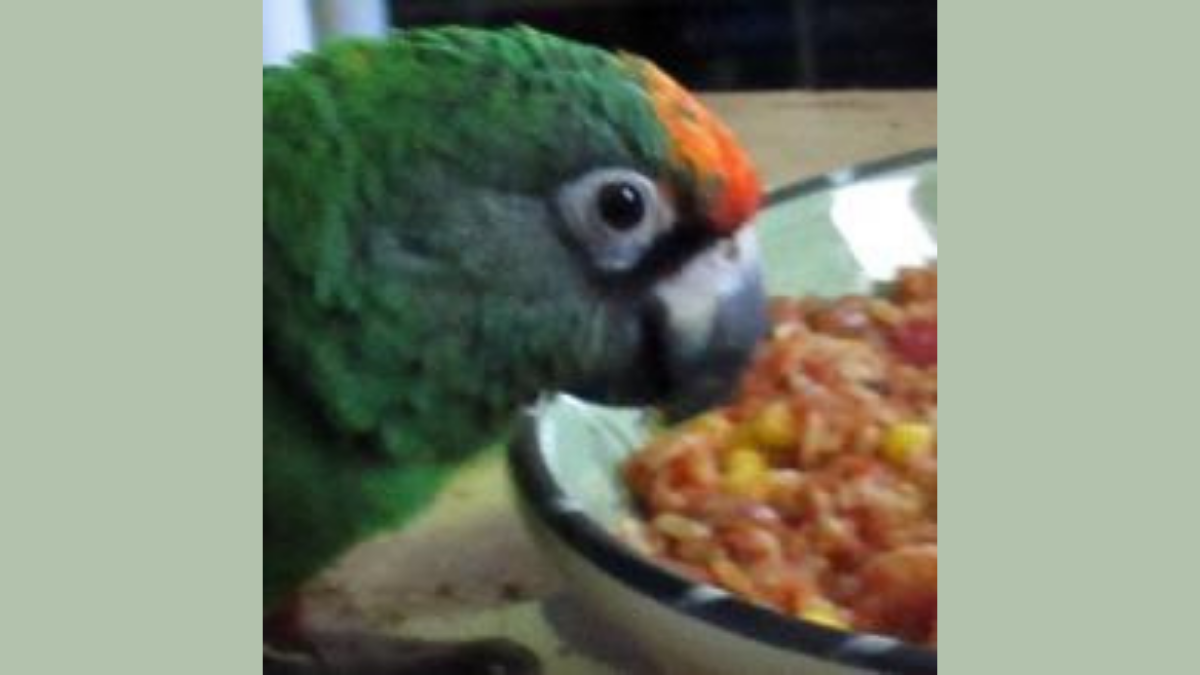
I currently live with Joey (shown in the photo above), a 22-year-old Jardine’s parrot I acquired as a baby. Joey understands what I tell him, and speaks to me in context. When I ask him to do something, and he doesn’t want to, he very clearly says “No.” I learned that if I insisted, he would bite. The picture shows him sharing my lunch, a daily occurrence.
Throughout the book, Dr. Pepperberg stresses many times that birds are intelligent, curious, and social animals who should not be locked up in a cage all day. Whatever pet someone acquires, they should realize that it is their job to deal with their physical needs, and to give them the socialization that they need to become wonderful companions.
Alex and Dr. Irene Pepperberg spent a lot of time together talking, learning new things, and hanging out. Alex was very clear about what he wanted to eat — if he said banana and was offered a grape, he threw it back. He wasn’t always in the mood for training, and said “Wanna go back.” Like most parrots, he could be bratty and destructive. He learned to say “I’m sorry” eventually and was forgiven.
Alex was only 31 when he died in 2007, and his last words to Dr. Irene Pepperberg were “You be good, I love you. See you tomorrow.” Everyone who had worked with Alex was devastated, and the animal lovers all over the world mourned with them.
Please visit https://alexfoundation.org/ to help support Dr. Irene Pepperberg’s continuing research and learn more about the incredible world of parrots.
Article and photo credit: Sue Anderson
Note for affiliate links: As an Amazon Associate I earn from qualifying purchases. Thank you for helping support Magdalene Journal with any of your purchases through affiliate links.
 Magdalene Journal
Loved this heartfelt article! Made me love birds more than I already did, if that is possible!
LikeLike
Wonderful article Sue! Definitely educating.
LikeLike