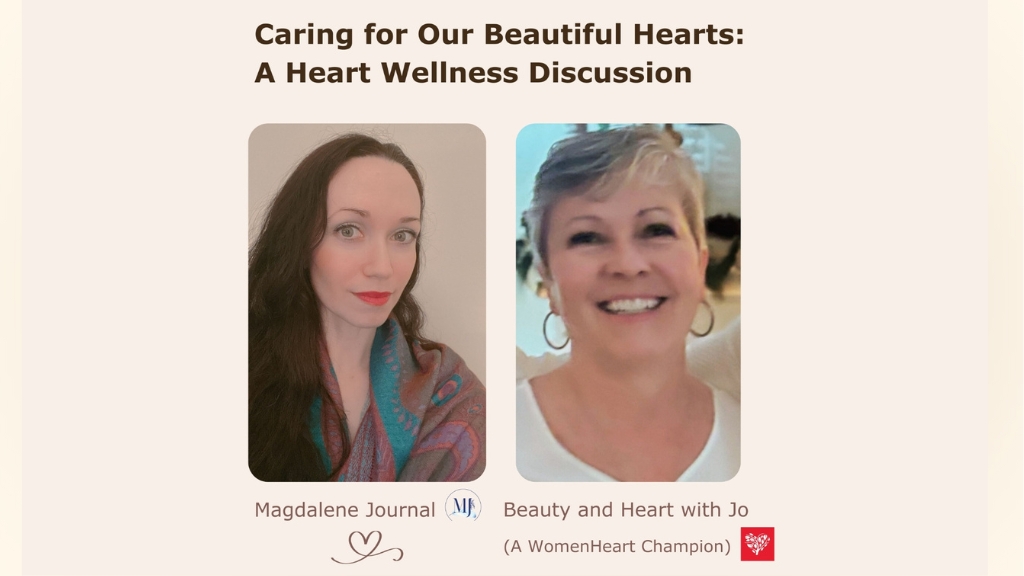
Season 2 Episode 1. Welcome to the Magdalene Journal Podcast, where we explore wellness, creativity, and inspiration. In this episode, Jo of “Beauty and Heart with Jo” joins us for a wellness discussion focused on women’s heart health. Jo shares the story of her personal heart health journey and how this experience led her to become a WomenHeart Champion: an advocate for women living with heart disease. You’ll learn why heart health education matters for everyone, how women’s symptoms can present differently, and how stress reduction, self-advocacy, and compassionate self-care can all play a powerful role in prevention and healing.
Resources mentioned in this episode:
WomenHeart links shared here with much gratitude for the essential work of the WomenHeart community and their ongoing advocacy for women’s heart health.
WomenHeart: https://www.womenheart.org
SisterMatch Program: https://www.womenheart.org/sistermatch/
Follow Jo on social media: Beauty and Heart with Jo
https://www.instagram.com/beauty_and_heart_with_jo
Discover more about Magdalene Journal at https://magdalenejournal.com/
Produced by Magdalene Journal and Beauty and Heart with Jo, with additional production support from Mind Body Voice Productions. (https://mindbodyvoiceproductions.com/)
This episode is intended for informational purposes only and does not constitute medical advice. The views expressed are not a substitute for professional medical care. Please consult your physician or qualified healthcare provider before making any health-related decisions.
Listen to this episode on Apple Podcasts, Spotify, or YouTube at these links – Apple: https://podcasts.apple.com/us/podcast/caring-for-our-beautiful-hearts-a-womens-heart/id1844102114?i=1000744329935 Spotify: LINK COMING SOON or YouTube: LINK COMING SOON
(Note: This page includes the full transcript of the episode below. An informative disclaimer appears again at the end of the transcript.)
Transcript:
Erica Magdalene, Host:
Hi, everyone. Please note that this episode is intended for informational purposes only and does not constitute health or medical advice. Neither I nor my guest are medical doctors and we are not teaching you how to manage your health. Please consult your physician or a qualified health care provider before making any medical or health-related decisions.
Welcome to the Magdalene Journal podcast. So as part of Magdalene Journal’s focus on wellness, today we’re talking about women’s heart health and caring for our bodies. So today, I’m going to be speaking with someone who is very special to me: Jo, of Beauty and Heart with Jo. She’s a WomenHeart Champion, a women’s heart health advocate, and she’s also my aunt! Which makes this conversation extra meaningful. Jo, thank you so much for being here with me today.
Jo:
Thank you Erica, thank you so much for having me. I’m really happy to be here.
Erica:
Oh, I’m so happy you’re here too! So if you could tell us a little bit more about your advocacy in this area and what that means to you, especially heart health specific to women?
Jo:
Yes, Women Heart is the National Coalition for Women Living with or at Risk of Heart Disease. It has been around for over 20 years. And as WomenHeart Champions, and as you mentioned, all Women Heart champions are women living with heart disease. We’ve all gone through an extensive training through the Mayo Clinic that helps us learn how to share our stories.
And the three areas that I often think of is SEAC. So we support, educate, and advocate for women. And the three different areas: support is where we have Women Heart support groups throughout the whole country. There’s over a thousand Women Heart champions right now. So we support. We go into hospitals when women have experienced a heart attack or surgery. And we offer them comfort and support.
We also offer red bags of courage, which are just filled with so much great information and where and how to get support. And then education is where we go out into the neighborhoods and offer workshops and speak at different seminars, and it’s all volunteer work.
And then advocacy I’m very passionate about, which is where we go and advocate for women’s heart health and needs that are specific for women’s health. And so that wraps it up. Once a year we go to Advocacy Day in Washington, D.C., which is so exciting, and really speak to members of Congress and try to get support for more funding specific to women’s health.
Erica:
That’s incredible. It touches so many levels of connection with women, where, as you were saying, whether it’s one-to-one with women who are in the hospital going through such an overwhelming experience, and then reaching out on that advocacy level, reaching lawmakers and decision-makers to really support us in this area. That’s incredible.
And I wanted to also ask you as well if you’d like to kind of touch on some of your own personal experience with heart disease and what, you know, how that led you into this area of advocacy?
Jo:
Yes, well, learning to live with heart disease was the first part of my journey. And then heart disease gave me a purpose at how to help others and share this information. And Women Heart gave me the platform in which to share everything that I’ve learned on this journey.
My own story came about almost eight years ago now. And I thought of myself as the picture of health until I was at my nephew’s wedding, your cousin’s wedding, and just didn’t feel right the whole day. And the first thought, oh, maybe it’s nerves.
Making the first big mistake of driving myself to the hospital, et cetera, et cetera. I was diagnosed with a SCAD heart attack. SCAD stands for spontaneous coronary artery dissection. Now, that’s a mouthful.
Erica:
Whoa.
Jo:
And I’ve learned an awful lot. And it’s a type of heart attack that primarily does affect women and usually younger women. So that made me feel a little better. At least I was in with the young women. At that time I was 55 years old.
And after being misdiagnosed a few times and having problems with the wrong dosage of medications, I finally got it straightened out. And now I’m happy to say I’m not only living with heart disease, but I would say thriving.
Erica:
That’s excellent. That is wonderful to hear. And I definitely just want to say I’m so grateful that you’re doing well and that you’re thriving, because it is a very scary and very concerning thing to go through for sure.
And on that note, too, as you were describing, you know, being at this wedding, this family wedding, and having these feelings come over to you, that really made me think about how women’s symptoms do tend to manifest differently from men’s symptoms. And can you speak to that a little bit of what women in particular should look out for?
Jo:
Yes, definitely. In my own case, it wasn’t that Hollywood crushing pain that you see, you know, clenching your chest. I just had a feeling of discomfort, almost like an impending sense of doom, a tightness, and a pressure in my chest. And then a shortness of breath began to kick in.
And that’s when I thought, hmm, I’ve got to get this taken care of. So I caution women not to try to think it away. Know your body. You know when something’s not right. So trust in your instincts and get things checked out.
Erica:
Absolutely. Yes, I think that’s a huge part of it, learning and researching about how symptoms can manifest differently. And also what you spoke to earlier about something that I think a lot of women are socialized to do of like, well, I don’t want to be a bother. It’ll be fine. We’ll put this to the side.
And would you say that is a huge part of our wellness too, of being self-aware and speaking up and like you said following our intuition if something doesn’t feel right?
Jo:
Exactly, exactly. So many times we just don’t want to make a scene, don’t want to look foolish. And there’s being told, you know, you’re probably just stressed or you’re probably having anxiety. If you know your body, you have to be persistent until you get the diagnosis that is correct.
Erica:
Absolutely. Absolutely. And as kind of as you were mentioning before, too, about how you said something to the effect of you felt like you’re the picture of health and everything is fine. What would you say to some women who do feel similarly like, well, I, you know, I think I’m doing great. I haven’t, you know, come across any issues. How and why should we be aware and proactive about our heart health?
Jo:
Because so many variables are involved. In my case, I have, or we have, I’m sorry to tell you, it’s family history. I wasn’t aware of how strong it was throughout our family, family history of heart disease, particularly on women’s sides.
And also stress. SCAD, in my case, was a stress-induced problem. And I always thought, oh, so, you know, everything’s cool. Everything’s fine. But stress will manifest itself someplace. And I think of stress as it can find your Achilles heel or your weak spot. And in my case, it was my heart.
So through all of this diagnosis, I found I also have coronary spasms, also known as Prinzmetal’s angina. It is a form of angina or chest pain that can come on at rest. A lot of people think of angina as when you’re out shoveling the snow and you get that heart attack. What I’m prone to happens at rest.
So what can induce, cause that is stressful situations. And although you might rally during this stressful situation, it sometimes shows itself after the fact. So please, my message to everyone out there is two words I hope we never use together is just stress. So often we say, oh, she’s just stressed. Absolutely. It’s a word that disqualifies what you’re really feeling. And stress can be a killer. Manage your stress.
Erica:
I think that’s such an important point of a word like just where it’s minimizing. And I think we do in society tend to minimize our stress and try to push harder and value this idea of pushing ourselves to burnout sometimes. And it’s not worth it. And we do not want to go there on a personal level, too.
I also am really grateful for your openness and transparency because I just think knowing is, sounds a little frightening, but it’s the fact is heart disease is the number one killer of women and men in America, the number one killer. But the good news when you hear that it’s like, oh, that’s frightening. But the good news is it’s 80 percent preventable. That’s huge.
Eighty percent, that is incredible. Would you say some of the ways of prevention, you definitely mentioned the reduction of stress, which is very essential. Are there other areas in terms of, I guess, like what we’re consuming, like food or, you know, any other areas of our life that contribute to that?
Jo:
Definitely. And although the family history that we have no control over, but the other like 80 percent, whether it be finding a diet that’s best for you, and that’s a realistic diet, not that we’re going to New Year’s resolution, let’s do everything at once.
But a realistic lifestyle changes that whether it’s just walking a few minutes each day and each day increasing your healthy eating habits and finding something that you enjoy doing and you can stick with it.
Erica:
And then also I was wondering too, because the stress being such a huge part of it in your learnings and research and advocacy work, are there some specific tips you have so that we can live a more stress-free lifestyle?
Jo:
Yes, so many things. And it’s really honestly been a process, learning how to minimize stress, manage stress, and most importantly, knowing your triggers and being respectful to your triggers and honoring yourself in saying, if this is an overwhelming situation for me, I have to manage walking away from it and what I can do in face of it.
And not feeling, this is a big one, not feeling that you have to explain yourself to everyone else. You have to be responsible for your own wellness and self-care.
Erica:
Absolutely. Much easier said than done.
Jo:
Exactly.
Erica:
No, that’s so important. And I think that kind of goes back to what we were talking about earlier, especially in regard to women and how we tend to express ourselves. We tend to not want to be the one to kind of speak up for ourselves always or want to intrude or think we’re making a bother or a fuss.
And I think when it comes to even interpersonal moments, if we’re in a situation, even if it’s with family, things can be stressful. If it’s a stressful conversation or a moment, you just have to take a minute, right? And just give yourself that space.
Jo:
Yes. I had, after the heart attack, I had a wonderful cardiac counselor because it was so overwhelming at first. Honestly, I could count the amount of times I’ve even had a cold.
So to suddenly be faced with this and then hear, oh, you’ve just had a SCAD heart attack, you have angina. Oh, and just for a little extra flavor, an aortic aneurysm. I was like, holy, holy, holy, this is a lot of news.
And then once I found this fabulous cardiac counselor, which through many insurance companies there’s a lot of different avenues of support that you can get if you just know about them.
And this one counselor told me, every day look at your hand, like make a little cup with your hand and think of it as that’s how much energy you’re filled with for the day. And if you choose to waste your energy on stressful situations or things you can’t control, you’re going to be down for the count for the rest of the day.
So I think of that often when I think of how to use my energy wisely each day.
Erica:
That is very wise. And it’s wonderful to have a visual that you can relate to and even a little gesture. Like I would imagine even if you’re just going about your day to kind of make that little, you know, hand cup movement and just remind yourself. That’s excellent.
There are so many resources that we have at hand to educate ourselves and be aware, like you were mentioning possibly reaching out to your medical provider or seeing if you have some kind of a counselor that can help you. What are some other resources that we can go to to learn more and educate ourselves?
Jo:
Well, with your cardiologist or whoever primary care doctor you’re speaking with, be sure that you take the time to get the right answer, stay on target, and find a doctor that you’re comfortable with, that you have a rapport with.
Because I think once you have a good partnership with your physician, then you can work as a team. And then to me, in my case, I felt more empowered to manage the things that I can control, knowing that my cardiologist was helping with the things that he was empowered to control.
Erica:
Absolutely. That is so excellent, especially that reminder of having the space for the answers. I think when we do go to our appointments, it can be so overwhelming and so much to focus on. And even something like making sure you have your pen and your notepad or taking notes on your phone or whatever note-taking arena is easiest for you to remember to do that.
Jo:
Yes. Very often a lot of other Women Heart champions I’ve communicated with say they actually ask the physician if it’s okay that they record the conversation.
Erica:
Absolutely. That sounds wonderful. Then you take away that extra stress of, okay, let me make sure I’m writing this all down and getting it all in the moment.
And then are there any websites? Definitely, I would say, I’m sure that Women Heart would have a lot of good resources in terms of going there. And what type of, I guess, like online or social references can we look at, too?
Jo:
It’s womenheart.org. And through Women Heart, they can lead you to so many other organizations. And at Women Heart, you can find champions in every state throughout the country that can come and speak at different seminars and courses.
They have Women Heart YouTube TV, which has great information of different clinicians that have come to speak with us. Yes, so there’s so much information out there. So that would be my number one resource to get started with.
And we even have a program called Sister Match. As a woman living with coronary disease or any type of heart disease, you can find a Sister Match with either the same demographics, the same type of disease, the same age, whatever you have a comfortable connection would be. And then you have actually somebody that’s had the same lived experience. It’s extremely helpful.
Erica:
Similar to what you were mentioning earlier with the aspect of going to women in a hospital who’ve recently had this experience and then the follow-up after. So you can have that sisterhood aspect of staying in touch and having someone there with you on the journey.
Jo:
That’s awesome. It was so important because I was so blessed to have so much great family around me to support me. I’m so fortunate to have fabulous physicians. But there was like this missing piece. Like, wait a minute, what the heck just happened to me?
And then to speak to other women that went through the same thing. And I thought when I was so frightened in the hospital, if somebody would have walked in a few years out as I am now, looking great and strong and confident, I would have said, oh shoot, okay, I’ve got this.
The last thing I would say to everyone out there is your one takeaway is know your numbers. Know your blood pressure, your cholesterol, your blood sugar, and your BMI. And then just listen to your body.
Erica:
Nice, nice. And one more question on that note. What are some good checkup times that have your blood work? And I know the numbers, and I used to, I still do, get afraid of, oh, I’d rather not know. I know I always just rather, you know, buried my head in the sand. But knowledge is power. And as we said earlier, if it’s 80 percent preventable, if we know what’s going on, we can do our part to control it.
Jo:
Absolutely. Knowledge is power, one hundred percent. And we need to move into that awareness without the fear, with owning the knowledge, and then we do the best we can. And then we live better, healthier, stress-free lives that way. That’s the goal.
Erica:
Love it. On the note of resources as well, if folks want to follow what you’re up to and see what you’re offering and what you’re doing in this area, can you remind us of your social channels where folks can find you?
Jo:
Beauty and Heart with Jo on Instagram and Facebook.
Erica:
Thank you so much for doing the work that you do. It’s an incredible step to go from having an experience like you’ve described and surviving that and moving into a place of thriving and also continuing to hold that space to help others on the journey. I think that’s really excellent, and I’m very proud to be related to someone like you.
Jo:
Well, thank you. The feeling is mutual. I appreciate it. Thank you for having me.
Erica:
Thank you for listening.
Disclaimer: The content in this podcast and in this podcast episode is for informative purposes only. Erica Magdalene is not a doctor and neither is her guest Jo. This episode is intended for informational purposes only and does not constitute medical advice. The views expressed are not a substitute for professional medical care. Please consult your physician or qualified healthcare provider before making any health-related decisions.
Photo credit: Erica Magdalene via Canva
 Magdalene Journal